Incident Triage Report: NetSupport Manager RAT (Easy As 123)
https://www.malware-traffic-analysis.net/2026/02/28/index.html
1. Executive Summary
On February 28, 2026, an analyst identified a critical security incident involving an internal Active Directory asset. Internal host DESKTOP-TEYQ2NR (10.2.28.88) was compromised by the NetSupport Remote Access Trojan (RAT). The initial compromise stemmed from a malicious web redirect during a standard web browsing session, resulting in a payload download from a malicious domain. The asset is currently active on the network and executing persistent Command and Control (C2) beaconing. Immediate containment is required.
Incident Metadata
| Field | Value |
|---|---|
| Incident Date/Time | 2026-02-28 @ 19:55 UTC |
| Severity | High / Critical |
| Infected Hostname | DESKTOP-TEYQ2NR |
| Infected Internal IP | 10.2.28.88 |
| Victim MAC Address | 00:19:d1:b2:4d:ad |
| Affected User Account | brolf |
| User Full Name | Becka Rolf |
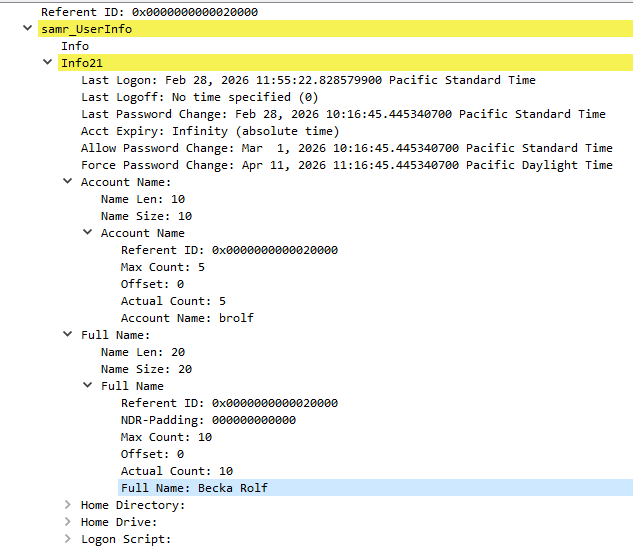
Figure 1: Wireshark packet details showing SAMR (Security Account Manager Remote) UserInfo structure (Info21), explicitly mapping the account name 'brolf' to the full name 'Becka Rolf'.
Technical Analysis & Timeline
1. Initial Access & Delivery (19:55 UTC)
- The victim host (
10.2.28.88) established a high-volume HTTPS connection with a legitimate Akamai CDN node (23[.]64[.]147[.]24). - The network traffic shows a massive, reassembled TLSv1.3 data stream originating from this CDN node. This stream appears to represent the initial delivery of the malicious payload to the client endpoint.
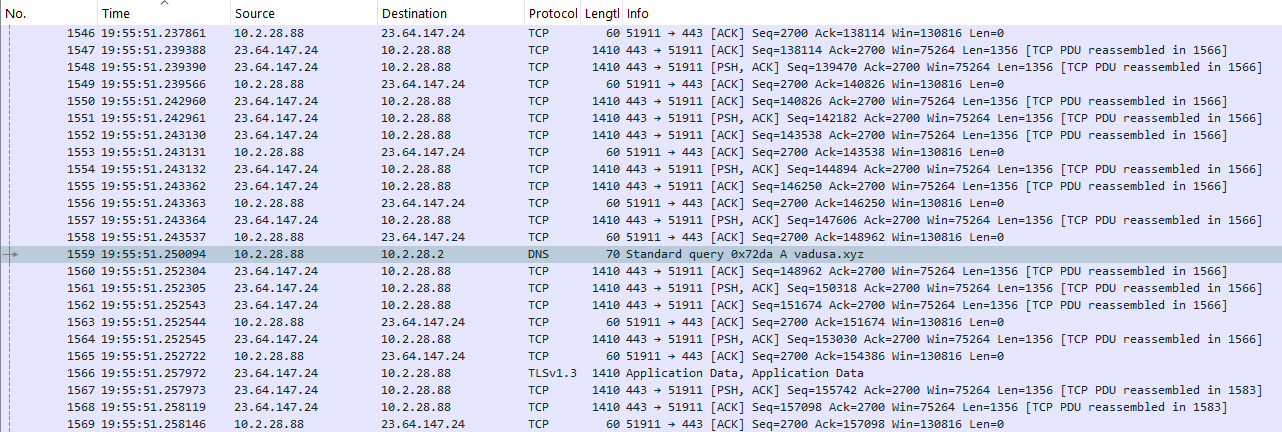
Figure 2: Chronological packet stream showing a sudden background DNS query for vadusa[.]xyz during active, legitimate HTTPS traffic with an Akamai CDN node.
2. Execution & C2 Discovery
- Upon execution of the payload on the local endpoint, the NetSupport RAT was silently installed.
- Immediately upon initialization, the malware attempted to discover its Command and Control infrastructure. The host sent DNS query ID
0x72dato the Domain Controller (10.2.28.2) to resolve the hardcoded C2 domainvadusa[.]xyz. - The DC resolved the domain to the attacker-controlled IP
45[.]131[.]214[.]85.
3. Command and Control (C2) Beaconing
- The client immediately initiated a TCP handshake with
45[.]131[.]214[.]85over port 443. - Session Initialization: The first application-layer packet sent by the client was an unencrypted
HTTP POSTrequest containing a baseline check-in handshake ("CMD" = "POLL\nINFO=1\nACK=1\n"). - Protocol Upgrade: Once the initial session handshake was established with the NetSupport Gateway, the malware immediately shifted to encrypted requests.
- All subsequent traffic consists of repetitive
HTTP POSTrequests utilizing the encryption flag (CMD=ENCD) and an encryption status identifier (ES=1), obfuscating the raw binary data payloads passed via theDATA=variable.
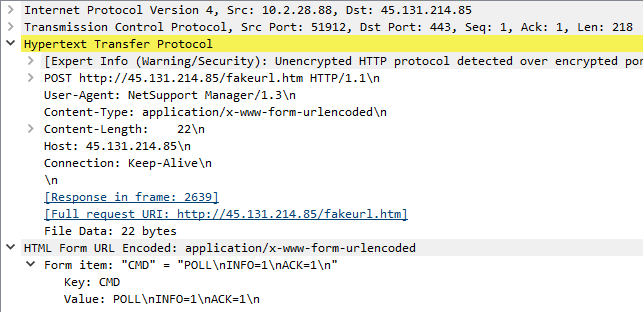
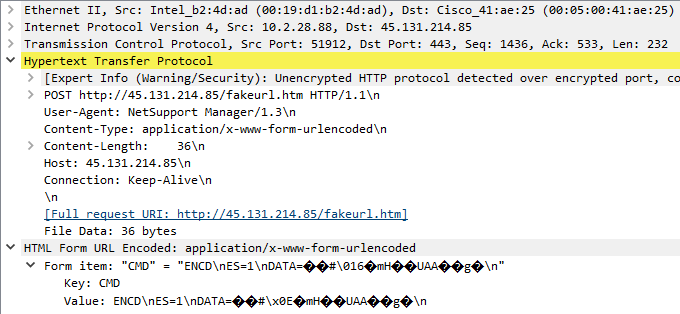
Figure 3: Dissected HTTP POST form data demonstrating NetSupport RAT traffic signatures, transitioning from a cleartext POLL session initialization to an ENCD encrypted data state.
4. Indicators of Compromise (IoCs)
- Malicious C2 Domain:
vadusa[.]xyz - C2 IP Address:
45[.]131[.]214[.]85(NetSupport Gateway) - Suspect Delivery Infrastructure:
23[.]64[.]147[.]24(Akamai CDN node utilized for initial payload hosting) - Network Signature:
POSTrequests toapplication/x-www-form-urlencodedendpoints containing the string valuesCMD=ENCDandES=1.
Recommended Remediation Actions
-
Network Isolation: Isolate
10.2.28.88from the local network segment immediately to prevent lateral movement within theEASYAS123domain. -
Credential Revocation: Force a password reset for the compromised user account in Active Directory and terminate all active concurrent Kerberos tickets for that user.
-
Endpoint Cleaning: Wipe and re-image
DESKTOP-TEYQ2NR. If forensic collection is required, take a volatile memory dump and disk image prior to wiping. -
SIEM/Firewall Block: Add
vadusa[.]xyzand the associated C2 IP to the enterprise firewall/proxy blocklist. Check SIEM logs to ensure no other internal hosts have queried this domain.